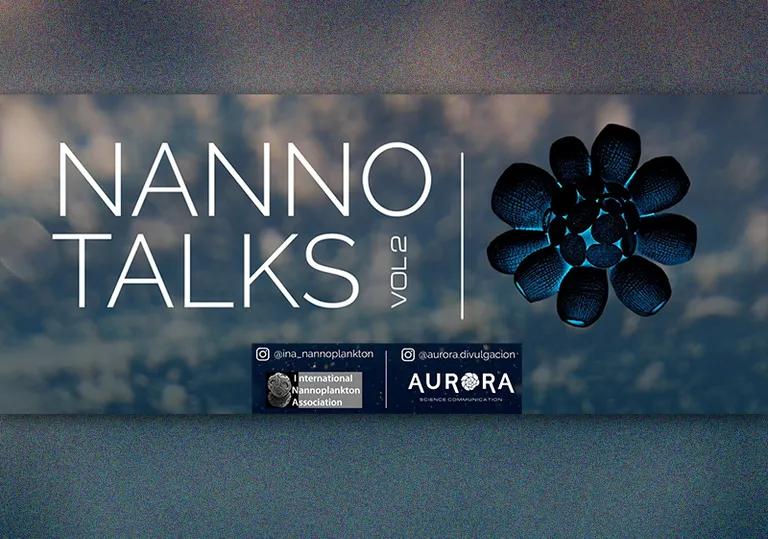
We are inviting our colleagues and fellow fossil enthusiasts to attend the second series of Nannotalks by the International Nannoplankton Association (INA). The next talk in the second series will be delivered by Dr. Luz Maria Mejia from ETH Zurich, with a title “Coccolith clumped isotopes point to a less extreme polar amplification during warm periods and a deeper that commonly-regarded coccolithophore habitat." The meeting is set to be held on the 24th of March, 2022 (14:00 UTC; 22:00 PhilST). The abstract is posted below:
ABSTRACT
Setting adequate and timely mitigation strategies in response to anthropogenic-caused warming requires improvement of climate model predictions, which requires reliable temperature and CO2 reconstructions. Temperature reconstructions based on widely-used proxies show different limitations. The application of clumped isotopes, which are uniquely dependent on thermodynamical processes, to calcite produced by coccolithophores, photosynthetic organisms limited to the photic zone, ensures that the reconstructed signal originates in the surface ocean. A combination of new coccolith separation methods allowed to obtain clumped isotopes from well preserved coccolith-rich samples from North Atlantic sediments during the last 16 Ma, and world-wide located core top samples. Upon the lack of evidence of vital and diagenetic effects, a consistently colder North Atlantic reconstructed from clumped isotopes compared to UK’37-derived temperatures, indicate a less extreme polar amplification than previously thought, and the potential need to reevaluate our understanding of widely-used temperature proxies. Part of this reevaluation should consider the evidence of a deeper habitat than generally regarded for coccolithophores, as clumped isotope calcification temperatures from core top coccoliths are colder than SSTs in low latitudes compared to higher ones. Clumped isotopes applied to coccolith calcite is a promising new proxy for temperature reconstructions, and new faster separation methods will allow its wider application.
More details can be found on the INA Facebook page.
More from the lab
- ThesisThesisMore Thesis →
Thesis Proposal: Jyll Radbert Botardo
The thesis proposal defense of Mr. Jyll Radbert P. Botardo was held on May 8, 2026 at 11:30AM. His proposal defense was part of the NIGS Thesis Proposal Colloquium for the 2nd Semester, AY 2025-2026. Mr. Jyll Radbert P. Botardo, a former University Research Associate I at the UP National Institute of Geological Sciences, presented…
 FieldworksMore Fieldworks →
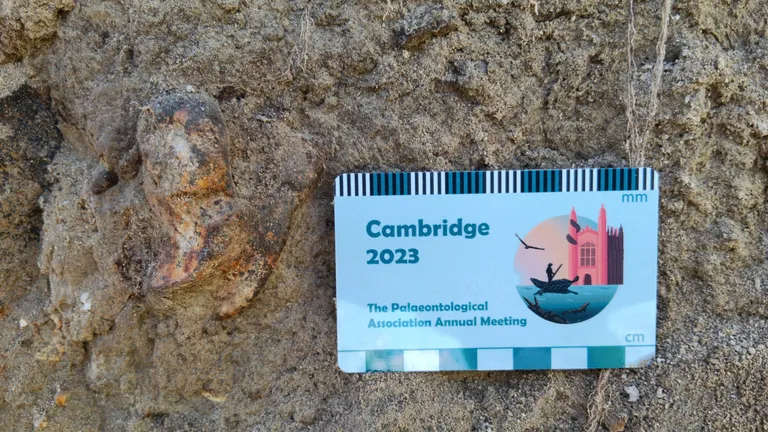
Nannoworks Conducts Paleontological Fieldwork in Bacnotan, La Union
Members of the Nannoworks Laboratory conducted paleontological fieldwork in the municipality of Bacnotan in La Union Province last July 6-13, 2026.
 NannoTalksMore NannoTalks →
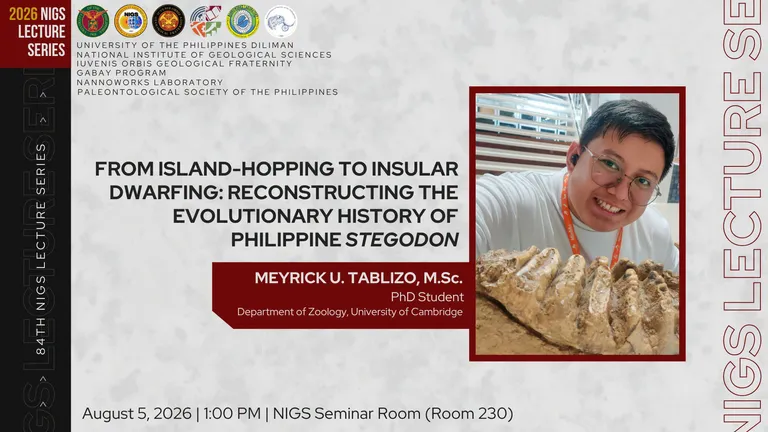
NIGS Lecture Series August 5, 2026: Meyrick U. Tablizo
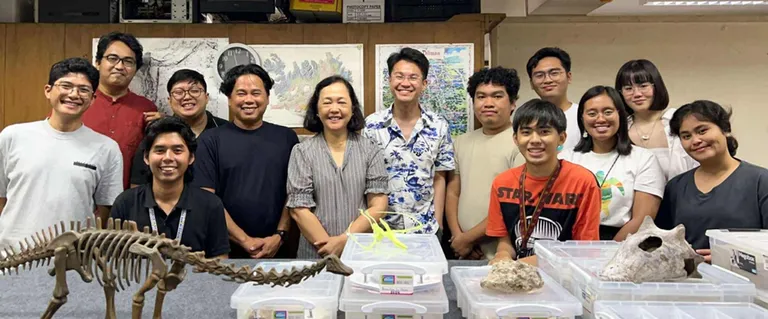
The Nannoworks Laboratory invited its alumnus Mr. Meyrick U. Tablizo last August 5, 2026 to deliver a talk on his research "From Island-Hopping to Insular Dwarfing: Reconstructing the Evolutionary History of Philippine Stegodon."
 NannoChatsMore NannoChats →
Dr. Jose Dominick Guballa chats about "nannos" during Nannochats
Nannoworks alumni and University of Toronto postdoctoral fellow, Dr. Jose Dominick Guballa returned to Room 014 for a Nannochats presentation on his research chapters on “Coccolithophore assemblage composition during the Greenland Interstadial–Stadial 20 transition and their response to the Youngest Toba Tuff (YTT) supereruption ∼74,000 years ago in the northeastern Arabian Sea”. The Toba
 NewsMore News →
Nannoworks Class of 2026
With the passing of another academic year, the Nannoworks Laboratory proudly congratulates the BS and MS graduates of the laboratory for AY 2025-2026!