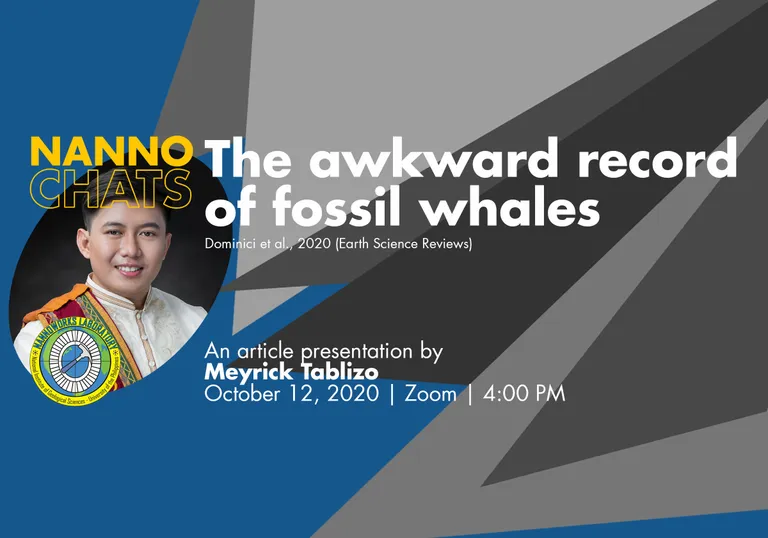
There will be a new NannoChats presentation to be presented by new NIGS faculty and laboratory member, Meyrick Tablizo. He will present the paper by Dominici and co-workers, published in Earth Science Reviews titled "The awkward record of fossil whales". The presentation will be held through Zoom at 4:00 PM.
ABSTRACT
Dominici, S., Danise, S., Cau, S., & Freschi, A. (2019). The awkward record of fossil whales. Earth-Science Reviews, 103057.
The habitat, actuopaleontology and global fossil record of crown cetaceans, today occupying apex positions in the marine ecosystem, is reviewed. A large Neogene-Quaternary dataset is built, covering the time span of the evolutionary radiation of crown Odontoceti and Mysticeti and including updated information on whale taxonomy, chronostratigraphy, geography, paleoenvironment, taphonomy and size. We outline an uneven chronostratigraphic and geographic distribution of fossils, which influences our understanding of global diversity trends. Notwithstanding the vast majority of whale carcasses sinks to bathyal depths, the fossil record is mainly associated with shelf paleoenvironments. The evolution of gigantic whales triggered the radiation of whale-fall communities, including a global bone-eating fauna that hampers the preservation of carcasses at bathyal depths. This “Osedax” effect may explain the unexpected distribution of the fossil record, particularly in the Pleistocene, when baleen whales became gigantic and the ecosystem engineers they are today. A review of the relative thickness of Pleistocene marine strata rules out artefacts of the rock record. The distribution of taphonomic grades suggests that the average skeletal completeness decreases during the Neogene and Quaternary, consistently with an increased efficiency of bioeroders. The frequency of complete and articulated skeletons is time-independent, suggesting a control by sedimentation rates. Quality of the record is expected to improve particularly from taxonomic studies dedicated to the rich, but unexplored South american record, documenting the record of little known productive regions, such as Africa, the Arctic and Antarctica, and the taphonomy and stratigraphic paleobiology of old and new findings.
More from the lab
- ThesisThesisMore Thesis →
Thesis Proposal: Jyll Radbert Botardo
The thesis proposal defense of Mr. Jyll Radbert P. Botardo was held on May 8, 2026 at 11:30AM. His proposal defense was part of the NIGS Thesis Proposal Colloquium for the 2nd Semester, AY 2025-2026. Mr. Jyll Radbert P. Botardo, a former University Research Associate I at the UP National Institute of Geological Sciences, presented…
 FieldworksMore Fieldworks →
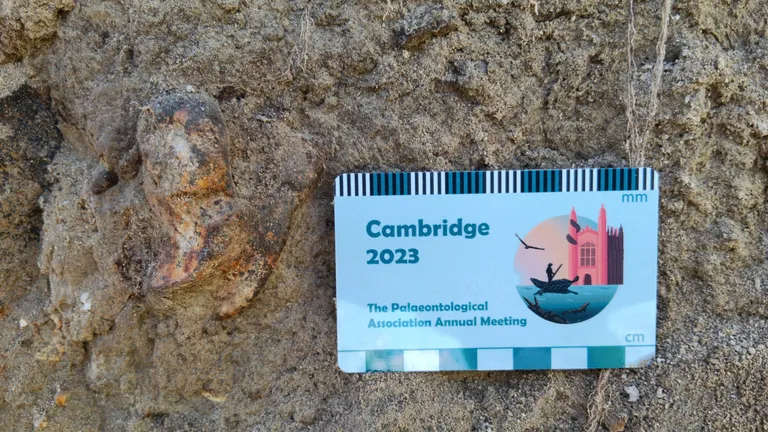
Nannoworks Conducts Paleontological Fieldwork in Bacnotan, La Union
Members of the Nannoworks Laboratory conducted paleontological fieldwork in the municipality of Bacnotan in La Union Province last July 6-13, 2026.
 NannoTalksMore NannoTalks →
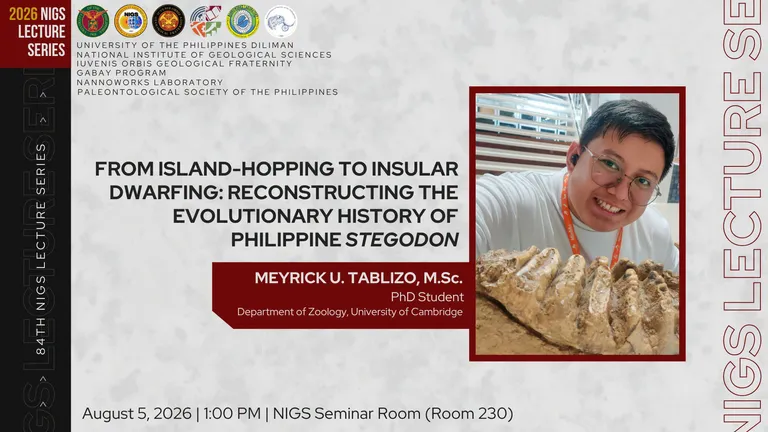
NIGS Lecture Series August 5, 2026: Meyrick U. Tablizo
The Nannoworks Laboratory invited its alumnus Mr. Meyrick U. Tablizo last August 5, 2026 to deliver a talk on his research "From Island-Hopping to Insular Dwarfing: Reconstructing the Evolutionary History of Philippine Stegodon."
 NannoChatsMore NannoChats →
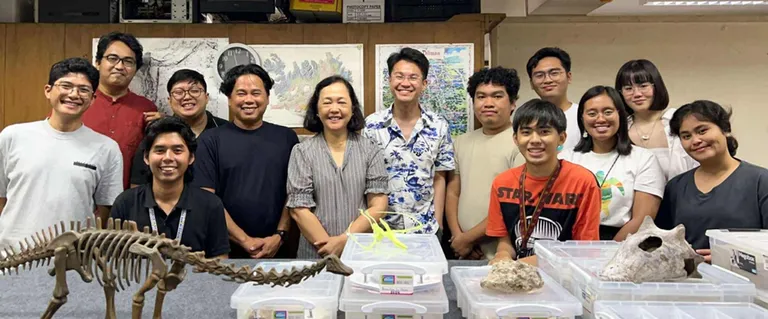
Dr. Jose Dominick Guballa chats about "nannos" during Nannochats
Nannoworks alumni and University of Toronto postdoctoral fellow, Dr. Jose Dominick Guballa returned to Room 014 for a Nannochats presentation on his research chapters on “Coccolithophore assemblage composition during the Greenland Interstadial–Stadial 20 transition and their response to the Youngest Toba Tuff (YTT) supereruption ∼74,000 years ago in the northeastern Arabian Sea”. The Toba
 NewsMore News →
Nannoworks Class of 2026
With the passing of another academic year, the Nannoworks Laboratory proudly congratulates the BS and MS graduates of the laboratory for AY 2025-2026!