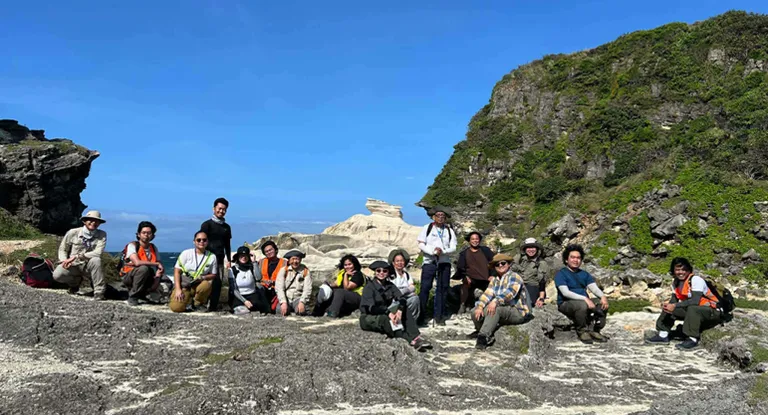
From November 13 to 16, 2025, Dr. Alyssa Peleo-Alampay, Dr. Allan Gil Fernando, Dr. Sandra Catane, and Dr. Leopoldo de Silva, Jr. led the 12 MS Geology students of the Geology 252 (Sedimentology) class on a fieldwork across selected sites in Ilocos Sur, Ilocos Norte, and La Union. The class was divided into three groups, with each group expected to discuss their observations at each location. Throughout the fieldwork, the groups recorded various clastic sedimentary rocks, including sandstones, mudstones, and mixed successions displaying sedimentary structures such as cross-bedding, ripple marks, graded bedding, and soft-sediment deformation features. Fossil fragments were also encountered within several horizons, providing clues to depositional settings and paleoenvironmental conditions.
One of the notable stops was in Kapurpurawan, Ilocos Norte, where the class examined the well-exposed calcarenites. Along the access roads approaching Kapurpurawan, volcaniclastic units such as volcanic breccias and tuffs, as well as exposures of andesitic lava flows, were observed, showing evidence of past volcanic activity and its influence on the regional geology.
The fieldwork provided hands-on experience in lithologic identification, stratigraphic logging, and sedimentary facies interpretation, which are skills needed for sedimentological training.
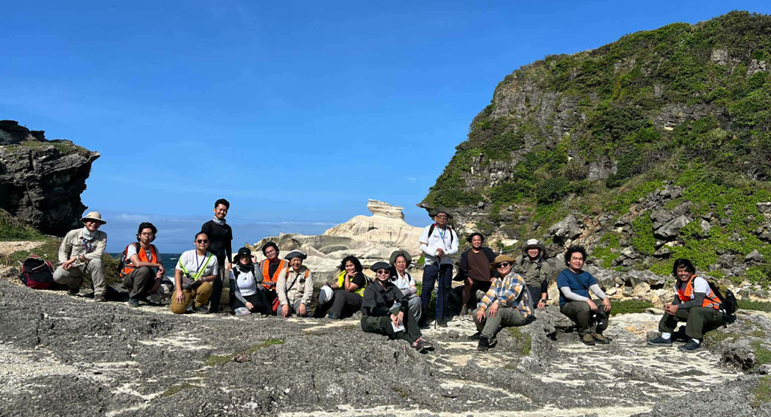
The faculty and Geology 252 students during their Geology 252 fieldwork
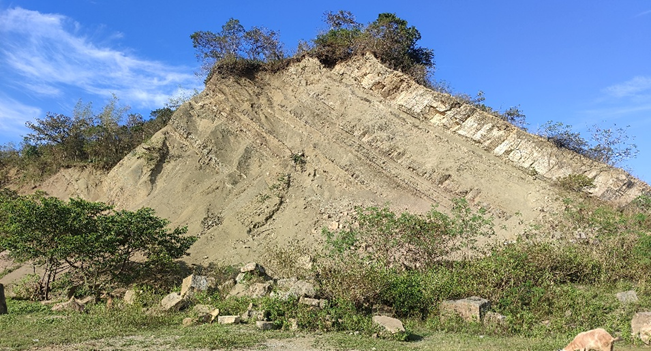
An outcrop exhibiting tilted allodapic limestones displaying distinct bedding in Santiago, Ilocos Sur
More from the lab
- ThesisThesisMore Thesis →
Thesis Proposal: Jyll Radbert Botardo
The thesis proposal defense of Mr. Jyll Radbert P. Botardo was held on May 8, 2026 at 11:30AM. His proposal defense was part of the NIGS Thesis Proposal Colloquium for the 2nd Semester, AY 2025-2026. Mr. Jyll Radbert P. Botardo, a former University Research Associate I at the UP National Institute of Geological Sciences, presented…
 FieldworksMore Fieldworks →
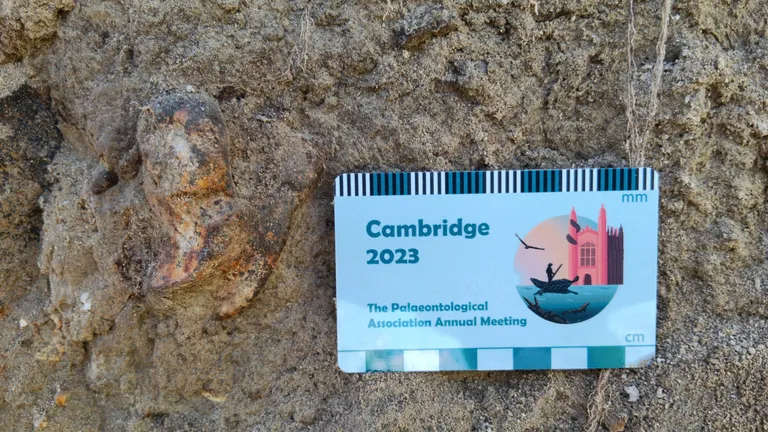
Nannoworks Conducts Paleontological Fieldwork in Bacnotan, La Union
Members of the Nannoworks Laboratory conducted paleontological fieldwork in the municipality of Bacnotan in La Union Province last July 6-13, 2026.
 NannoTalksMore NannoTalks →
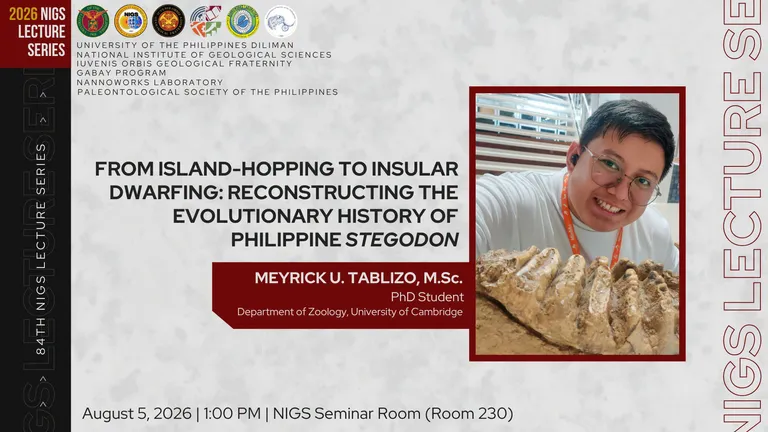
NIGS Lecture Series August 5, 2026: Meyrick U. Tablizo
The Nannoworks Laboratory invited its alumnus Mr. Meyrick U. Tablizo last August 5, 2026 to deliver a talk on his research "From Island-Hopping to Insular Dwarfing: Reconstructing the Evolutionary History of Philippine Stegodon."
 NannoChatsMore NannoChats →
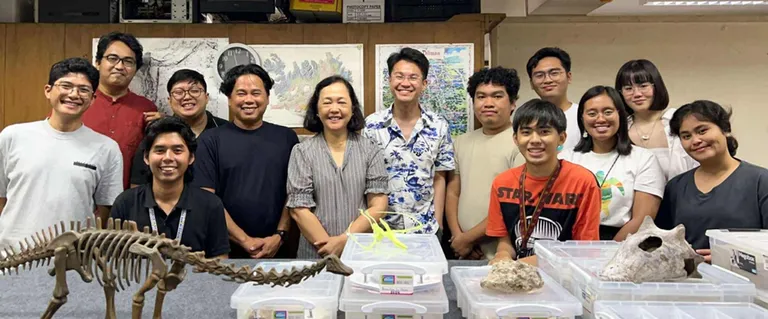
Dr. Jose Dominick Guballa chats about "nannos" during Nannochats
Nannoworks alumni and University of Toronto postdoctoral fellow, Dr. Jose Dominick Guballa returned to Room 014 for a Nannochats presentation on his research chapters on “Coccolithophore assemblage composition during the Greenland Interstadial–Stadial 20 transition and their response to the Youngest Toba Tuff (YTT) supereruption ∼74,000 years ago in the northeastern Arabian Sea”. The Toba
 NewsMore News →
Nannoworks Class of 2026
With the passing of another academic year, the Nannoworks Laboratory proudly congratulates the BS and MS graduates of the laboratory for AY 2025-2026!