Nannoworks Researcher Conducts Agent-Based Modeling Work and Taxonomic Research in Germany for Stegodon Dispersal Study
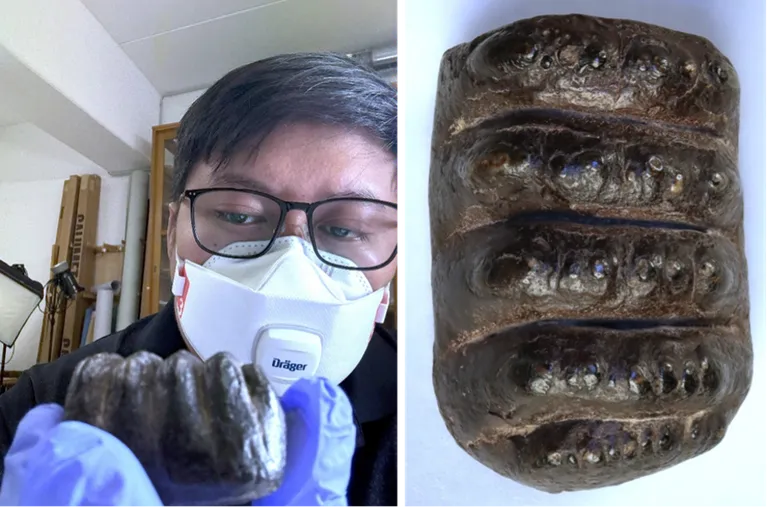
Meyrick Tablizo of the Nannoworks Laboratory conducted a research visit to Germany from March 15 to April 27, 2025, to advance ongoing work on the dispersal of Stegodon across insular Southeast Asia during the Pleistocene. The research trip was funded by the Role of Culture in Early Expansions of Humans (ROCEEH) Project (Heidelberg Academy of Sciences) through the international collaboration with Dr. Christine Hertler and the 2025 NIGS Research Grant. It involved the further development of the Stegodon SEAcross Agent-Based Model (ABM) at the Senckenberg Research Institute and Natural History Museum in Frankfurt am Main, as well as fossil examination at the Museum für Völkerkunde (Museum of Ethnology) in Dresden.
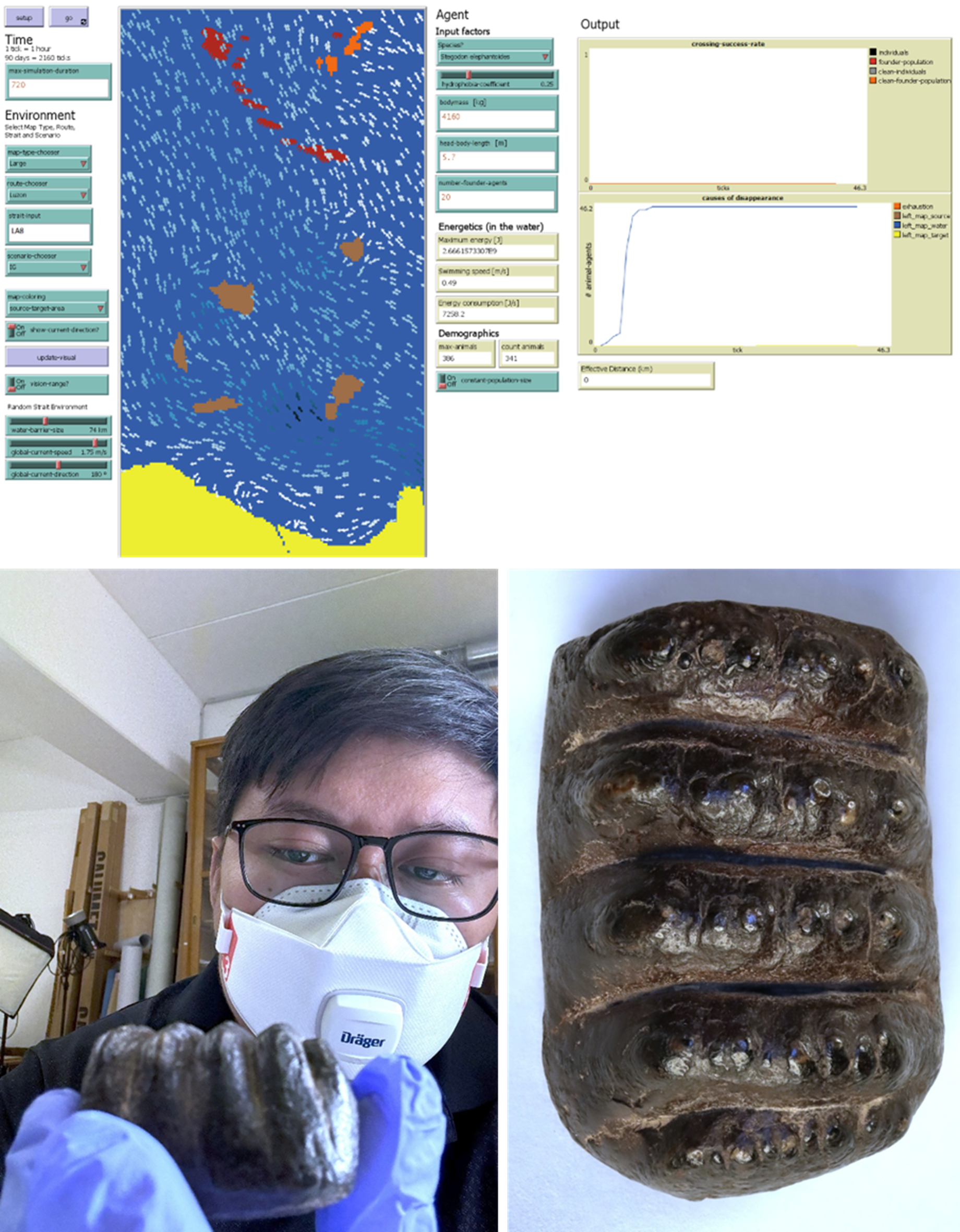
(Top) SEAcross ABM v. 1.1 NetLogo interface showing the Luzon Strait islands and a Stegodon population (red) attempting to cross from Batan, Sabtang, and Vohas Islands (orange) towards Luzon (yellow). Arrows indicate current direction while the shade corresponds to the current speed (white slower, dark blue faster). (Bottom) Meyrick examining the S. mindanensis holotype in Dresden and a close-up photograph of the specimen.
At Senckenberg, Meyrick focused on improving the SEAcross ABM (v.1.1 https://doi.org/10.5281/zenodo.15607919), which simulates the dispersal of extinct proboscideans (Stegodon and Elephas forms) across the islands and sea straits of Southeast Asia. The model aims to evaluate potential colonization pathways into the Philippines under current (interglacial) and glacial conditions. During the visit, he prepared new environmental layers for the model, including bathymetric DEMs and present-day ocean current data (January), replacing the generalized spatial input used in the earlier model, and integrated using the NetLogo platform.
Meyrick also visited the Museum für Völkerkunde in Dresden on April 17, 2025, as part of his NIGS-funded research entitled “Stegodon mindanensis Naumann, 1890: A Reassessment of the Holotype in Dresden, Germany.” It involved the direct examination and photographic documentation of the holotype of Stegodon mindanensis, a partial Stegodon molar, and another isolated molar ridge, previously identified as S. cf. mindanensis, that were used as talismans by a Manobo tribe in Agusan, Mindanao during the 18th Century. These specimens represent the first formally described vertebrate fossils from the Philippines, published by Heinrich Edmund Naumann in 1887 and officially renamed in 1890. Further taxonomic and morphometric analysis is ongoing.
More from the lab
- ThesisThesisMore Thesis →
Thesis Proposal: Jyll Radbert Botardo
The thesis proposal defense of Mr. Jyll Radbert P. Botardo was held on May 8, 2026 at 11:30AM. His proposal defense was part of the NIGS Thesis Proposal Colloquium for the 2nd Semester, AY 2025-2026. Mr. Jyll Radbert P. Botardo, a former University Research Associate I at the UP National Institute of Geological Sciences, presented…
 FieldworksMore Fieldworks →
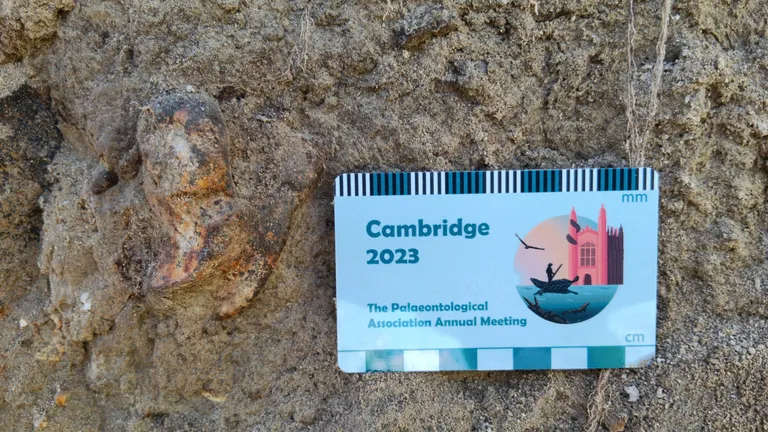
Nannoworks Conducts Paleontological Fieldwork in Bacnotan, La Union
Members of the Nannoworks Laboratory conducted paleontological fieldwork in the municipality of Bacnotan in La Union Province last July 6-13, 2026.
 NannoTalksMore NannoTalks →
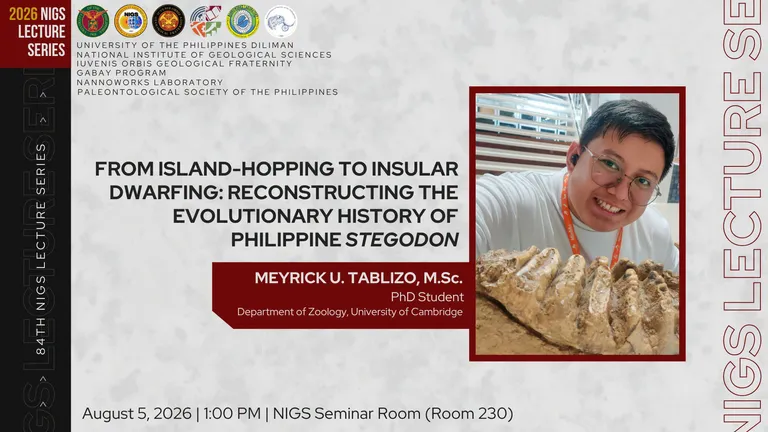
NIGS Lecture Series August 5, 2026: Meyrick U. Tablizo
The Nannoworks Laboratory invited its alumnus Mr. Meyrick U. Tablizo last August 5, 2026 to deliver a talk on his research "From Island-Hopping to Insular Dwarfing: Reconstructing the Evolutionary History of Philippine Stegodon."
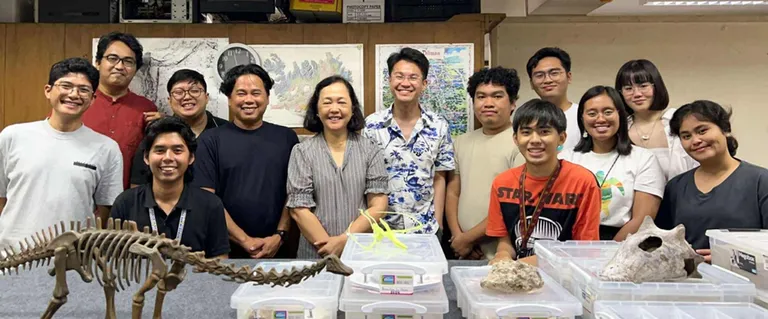 NannoChatsMore NannoChats →
Dr. Jose Dominick Guballa chats about "nannos" during Nannochats
Nannoworks alumni and University of Toronto postdoctoral fellow, Dr. Jose Dominick Guballa returned to Room 014 for a Nannochats presentation on his research chapters on “Coccolithophore assemblage composition during the Greenland Interstadial–Stadial 20 transition and their response to the Youngest Toba Tuff (YTT) supereruption ∼74,000 years ago in the northeastern Arabian Sea”. The Toba
 NewsMore News →
Nannoworks Class of 2026
With the passing of another academic year, the Nannoworks Laboratory proudly congratulates the BS and MS graduates of the laboratory for AY 2025-2026!