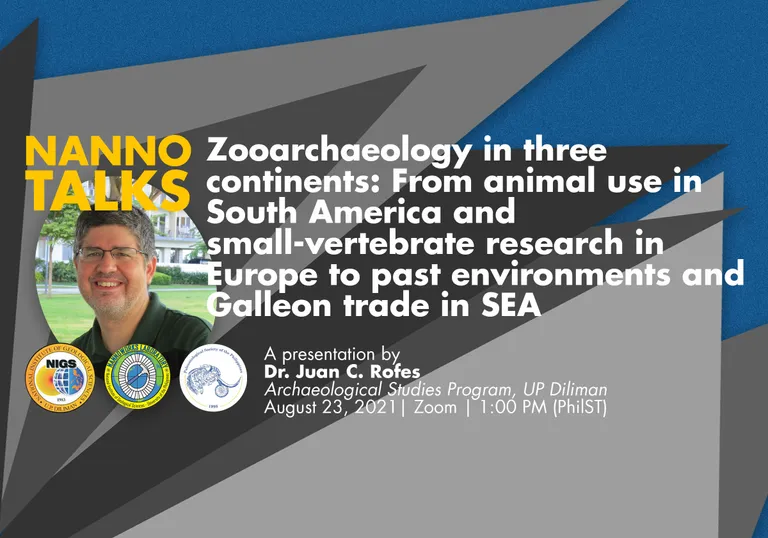
There will be a new NannoTalks presentation by Dr. Juan C. Rofes of the Archaeological Studies Program of the University of the Philippines, Diliman. It will be held virtually, via Zoom, on August 21, 2021 at 1:00 PM (Philippine Standard Time). His presentation is entitled "Zooarchaeology in three continents: From animal use in South America and small-vertebrate research in Europe to past environments and Galleon trade in SEA."
This talk is co-organized with the National Institute of Geological Sciences and the Paleontological Society of the Philippines.
The registration for the talk can be accessed in this link.
ABSTRACT
In plain words, zooarchaeology is the branch of environmental archaeology dealing with the study of animal remains from archaeological sites. Along the past 25 years, and over three different continents, I have learned how rich and complex this discipline can be. From early studies on the domestication, uses and ritual of South American camelids and guinea pigs in Peru, my country of origin, I moved to Europe where, initially, I focused my research on the systematics, palaeobiology, palaeoecology and biogeography of small mammals, particularly shrews from the well-known Spanish site of Atapuerca. After completing my PhD in Zaragoza, a government grant allowed me to devote to the reconstruction of past environments in the Cantabrian region, mainly based on the evolution of small-vertebrate assemblages from Quaternary caves in northern Iberia. Then, after being awarded a Marie Curie Fellowship of the European Union, I moved to Paris (i.e., MNHN/CNRS), where my research turned to understand the biogeographical histories and the effects of anthropization on populations of small mammals during the late Quaternary in Western Europe. Finally, three years ago, I was appointed as an associate professor at the Archaeological Studies Program of the University of the Philippines. Putting together all that I have learned before, I am currently delving into the systematics, biogeography and palaeoecology of the small mammals from Callao Cave (Cagayan Valley) in order to understand the interactions between environmental change and human development in Luzon during the last 70 thousand years. In parallel, I am developing a binational project to investigate the faunal translocations from the New World to SEA and vice versa in the frame of the Galleon trade and the environmental impacts of the latter over the Philippine Islands.
More from the lab
- ThesisThesisMore Thesis →
Thesis Proposal: Jyll Radbert Botardo
The thesis proposal defense of Mr. Jyll Radbert P. Botardo was held on May 8, 2026 at 11:30AM. His proposal defense was part of the NIGS Thesis Proposal Colloquium for the 2nd Semester, AY 2025-2026. Mr. Jyll Radbert P. Botardo, a former University Research Associate I at the UP National Institute of Geological Sciences, presented…
 FieldworksMore Fieldworks →
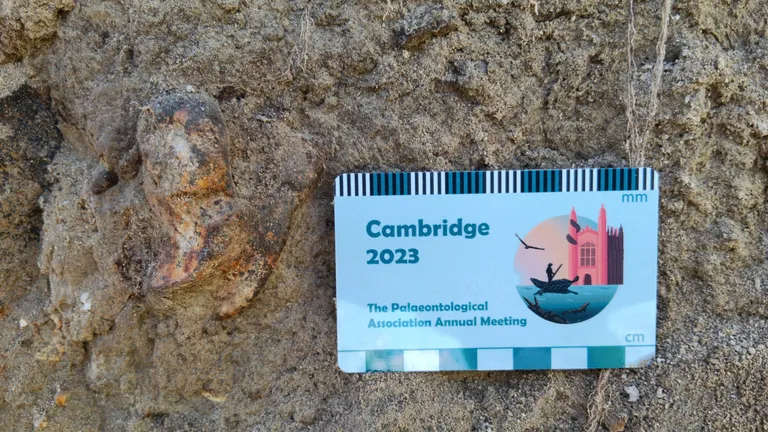
Nannoworks Conducts Paleontological Fieldwork in Bacnotan, La Union
Members of the Nannoworks Laboratory conducted paleontological fieldwork in the municipality of Bacnotan in La Union Province last July 6-13, 2026.
 NannoTalksMore NannoTalks →
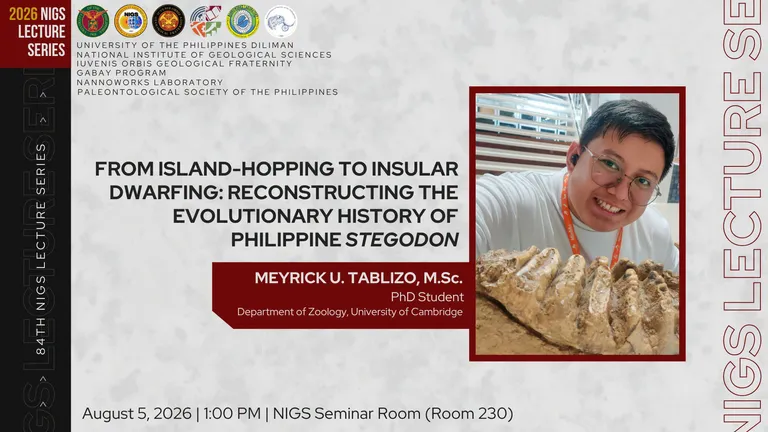
NIGS Lecture Series August 5, 2026: Meyrick U. Tablizo
The Nannoworks Laboratory invited its alumnus Mr. Meyrick U. Tablizo last August 5, 2026 to deliver a talk on his research "From Island-Hopping to Insular Dwarfing: Reconstructing the Evolutionary History of Philippine Stegodon."
 NannoChatsMore NannoChats →
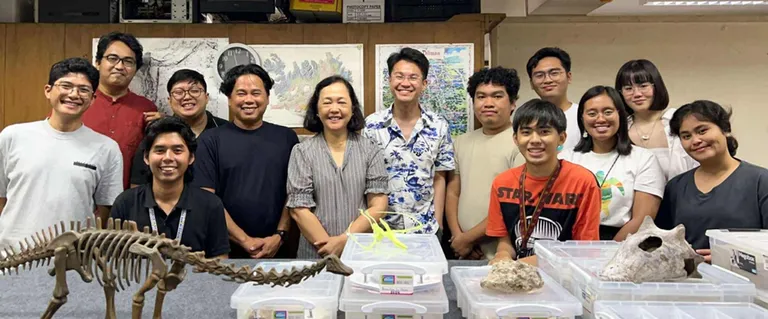
Dr. Jose Dominick Guballa chats about "nannos" during Nannochats
Nannoworks alumni and University of Toronto postdoctoral fellow, Dr. Jose Dominick Guballa returned to Room 014 for a Nannochats presentation on his research chapters on “Coccolithophore assemblage composition during the Greenland Interstadial–Stadial 20 transition and their response to the Youngest Toba Tuff (YTT) supereruption ∼74,000 years ago in the northeastern Arabian Sea”. The Toba
 NewsMore News →
Nannoworks Class of 2026
With the passing of another academic year, the Nannoworks Laboratory proudly congratulates the BS and MS graduates of the laboratory for AY 2025-2026!