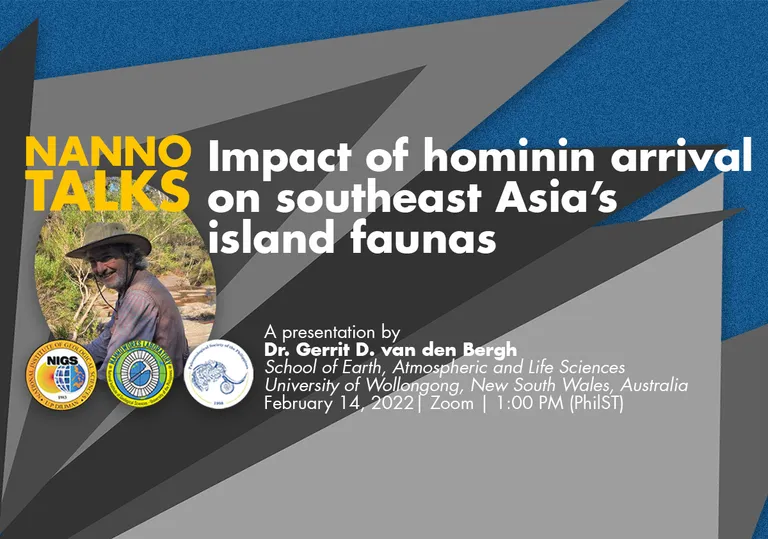
Last February 14, 2022 at 1:00 PM (Philippine Standard Time), Dr. Gerrit D. van den Bergh of the School of Earth, Atmospheric and Life Sciences of the University of Wollongong, New South Wales, Australia gave a virtual talk via Zoom entitled “Impact of hominin arrival on southeast Asia's island faunas.” His talk focused on his research on early Quaternary hominins and their effects on endemic fauna on Southeast Asian islands. A recording of the talk is posted below.
This talk was co-organized with the National Institute of Geological Sciences and the Paleontological Society of the Philippines.
ABSTRACT
Human influences, such as predation, burning, habitat destruction, or the introduction of commensals such as pigs and rats, are the most frequently cited causes for the extinction of megafauna during the Quaternary, together with climate change. Modern humans no doubt had, and still have, a major role in the global demise and extinctions of biota, and island faunas in particular have been heavily impacted by extinctions since Homo sapiens arrived. It has been suggested that we are currently in the middle of a 6th mass-extinction event, comparable in size to the end of Permian mass extinction or the one associated with the K-T boundary.
Until recently there was not much direct evidence for Late Pleistocene humans (Homo sapiens) hunting megafauna on islands, but this is changing rapidly. And once agricultural practices were introduced on islands during the Holocene, the impact of humans on island faunas seems to have accelerated, especially on smaller islands.
But has human impact always been so drastic? Over the last decades it has become clear that pre-modern hominins reached several islands in Southeast Asia, including Luzon and Flores, long before modern humans with boat technology colonized these islands during the Late Pleistocene. The islands of Flores, Sulawesi and Luzon all bear evidence of hominin presence during the Early to Middle Pleistocene, based on dated stone artefacts that range in age from 1.0 million year (Ma) on Flores, to 0.7 Ma on Luzon, and 0.2 Ma on Sulawesi. This is long before modern humans are thought to have first reached southeast Asia around 70,000 years ago, or perhaps even 120,000 years ago. Apart from stone artefacts as proxy evidence for hominin presence, on Flores there are also 0.7 Ma old hominin fossils known of what most likely represents the ancestral lineage of Homo floresiensis, the 1-m tall Late Pleistocene hominin only known from Liang Bua cave on Flores. And of similar body size is the most recently discovered member of the genus Homo from Luzon: Homo luzonensis. During this talk I will elaborate on what we know about the impact of these Early and Middle Pleistocene insular hominins on the endemic faunas they encountered on these islands. Many SE Asian islands had members of the elephant family roaming around, some just 1 m tall at the shoulders. These are now all gone, so what happened to them?

More from the lab
- ThesisThesisMore Thesis →
Thesis Proposal: Jyll Radbert Botardo
The thesis proposal defense of Mr. Jyll Radbert P. Botardo was held on May 8, 2026 at 11:30AM. His proposal defense was part of the NIGS Thesis Proposal Colloquium for the 2nd Semester, AY 2025-2026. Mr. Jyll Radbert P. Botardo, a former University Research Associate I at the UP National Institute of Geological Sciences, presented…
 FieldworksMore Fieldworks →
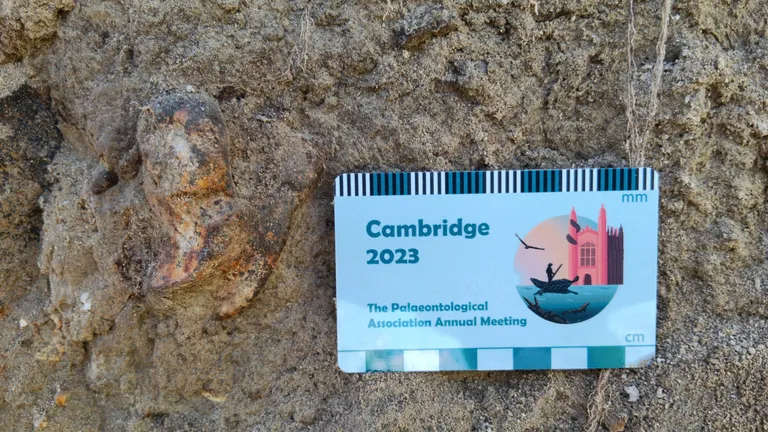
Nannoworks Conducts Paleontological Fieldwork in Bacnotan, La Union
Members of the Nannoworks Laboratory conducted paleontological fieldwork in the municipality of Bacnotan in La Union Province last July 6-13, 2026.
 NannoTalksMore NannoTalks →
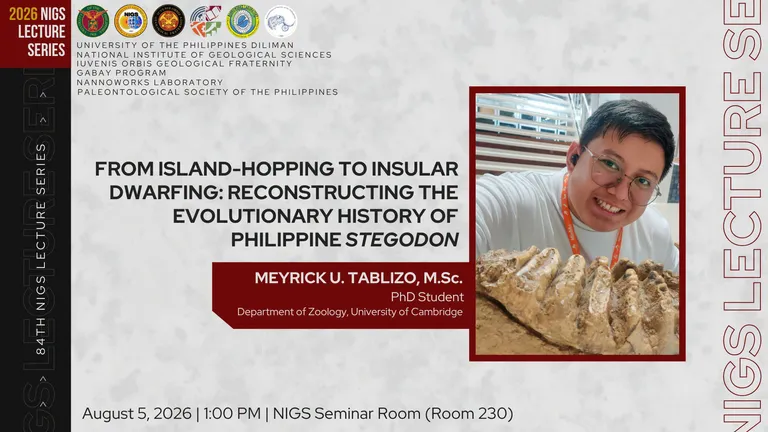
NIGS Lecture Series August 5, 2026: Meyrick U. Tablizo
The Nannoworks Laboratory invited its alumnus Mr. Meyrick U. Tablizo last August 5, 2026 to deliver a talk on his research "From Island-Hopping to Insular Dwarfing: Reconstructing the Evolutionary History of Philippine Stegodon."
 NannoChatsMore NannoChats →
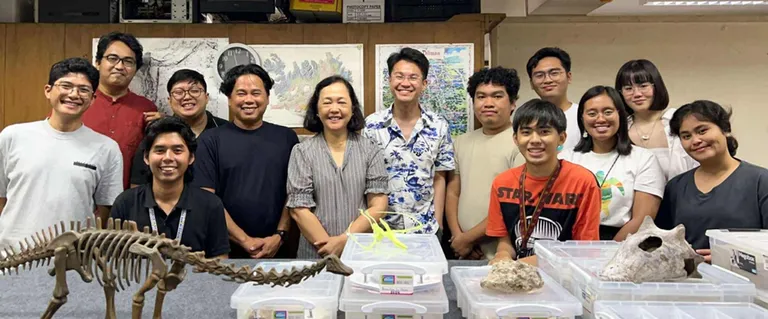
Dr. Jose Dominick Guballa chats about "nannos" during Nannochats
Nannoworks alumni and University of Toronto postdoctoral fellow, Dr. Jose Dominick Guballa returned to Room 014 for a Nannochats presentation on his research chapters on “Coccolithophore assemblage composition during the Greenland Interstadial–Stadial 20 transition and their response to the Youngest Toba Tuff (YTT) supereruption ∼74,000 years ago in the northeastern Arabian Sea”. The Toba
 NewsMore News →
Nannoworks Class of 2026
With the passing of another academic year, the Nannoworks Laboratory proudly congratulates the BS and MS graduates of the laboratory for AY 2025-2026!